

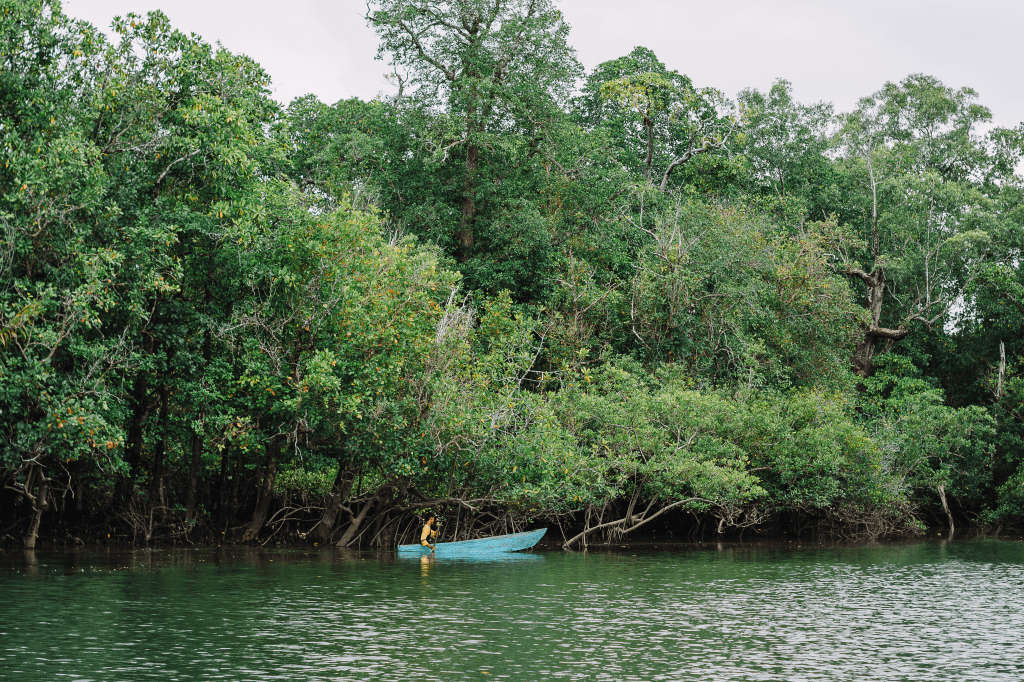
At the edge of the sea, where land dissolves into a maze of roots and tidal waters, the mangrove forests of Papua stand quietly, yet powerfully, as guardians of life.
For the Indigenous community of Kaitaro in Bintuni Bay Regency of West Papua Province, these forests are not just part of the landscape. They are home, livelihood, and identity woven into one living system.
A Forest That Sustains
As explained by the Head of the Manokwari EcoNusa Foundation Office, Charles Sroyer, Friday, April 17, 2026. In Kaitaro, mangroves are not seen as resources to be exploited, but as a living space that sustains everyday life. The forest provides fish, crabs, and other coastal species that become daily food sources. Small channels winding through the roots serve as natural pathways, connecting villages to the sea.
But beyond what is visible, mangroves also protect what cannot always be seen, the balance of life itself. For the people of Kaitaro, this is not scientific theory. It is lived experience, passed down through generations. Life in Kaitaro moves with the rhythm of the sea. As a result, traditional knowledge and local practices play a key role in protecting the ecosystem.
Across Papua, similar patterns can be seen: Indigenous communities act as natural stewards of coastal ecosystems, maintaining sustainability through customs that regulate how resources are used.
Between Mangroves and Megaprojects
Kaitaro is also part of a district experiencing significant economic momentum. Recent data shows that Teluk Bintuni Regency’s economy has expanded rapidly, with regional GDP (PDRB) reaching around Rp52.36 trillion in 2024, marking a sharp 29.22% increase year-on-year.
Even more striking is its high income level per capita, which reached approximately Rp574.98 million per person annually in 2024, and continued rising to about Rp621 million per capita in 2025.
These figures place Teluk Bintuni among the highest per-capita economic regions in Indonesia, largely driven by strong industrial activity, particularly in natural gas and processing industries.
A Grounded Model of Development
Kaitaro offers a powerful perspective within Papua’s broader economic transformation. While Teluk Bintuni’s macroeconomic indicators reflect rapid growth and high income levels, villages like Kaitaro demonstrate how development can remain grounded, growing from ecosystems rather than replacing them.
Here, the mangrove is not just part of the environment. It is part of the economy. And more importantly, it is part of a system that has sustained life long before modern indicators began measuring it. As tides rise and fall along the coast of Kaitaro, they carry more than water. They carry the rhythm of a living economy, one that exists quietly alongside billion-rupiah industries. Kaitaro’s mangroves form the basis of a community-based economy that remains resilient even as the region around it grows rapidly.
https://www.tempo.co/lingkungan/begini-mangrove-menjaga-ruang-hidup-masyarakat-adat-kaitaro-2130009

 West Papua Now