

For generations, the forests, hills, rivers, and coastal lands of Papua have carried more than just ecological richness. They hold memories, identity, and the spiritual foundations of the communities who have lived with them since time immemorial.
But as Papua moves deeper into a new era of development — marked by expanding infrastructure, investment flows, and rapid economic change — one question rises louder than ever:
Will Indigenous Papuans remain custodians of their own land?
This question sits at the heart of a new national push to safeguard Tanah Ulayat — customary lands that belong collectively to clans and tribes across Papua.
A New Era for Tanah Ulayat
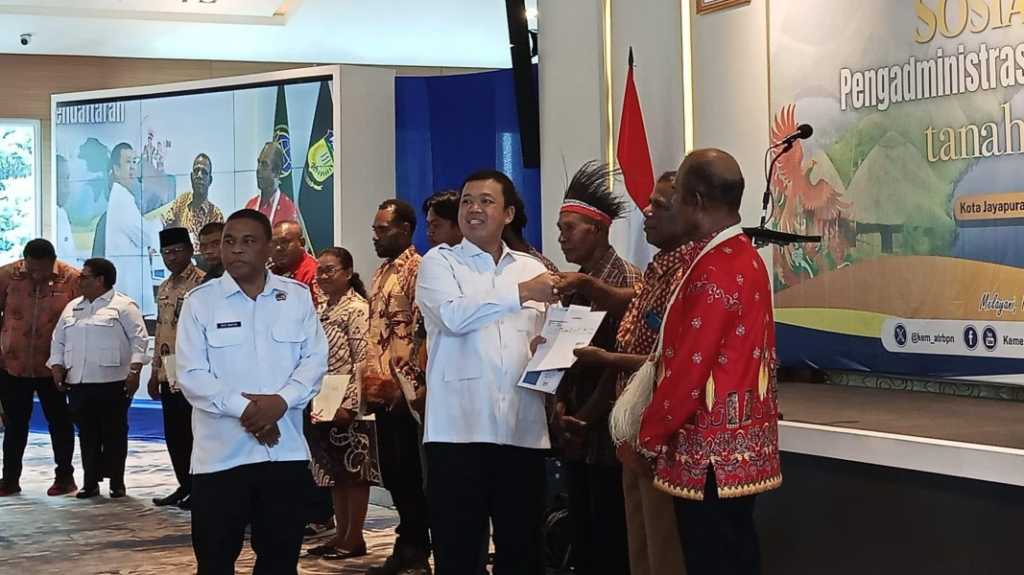
At a public event in Jayapura on on November 19, 2025, Nusron Wahid — Minister of Agrarian Affairs and Spatial Planning / Head of the National Land Agency (ATR/BPN) — made a firm declaration: Indigenous Papuans must in the driver’s seat on their own economic growth.
This is a part of a broader initiative under the recently issued regulation (Ministerial Regulation No. 14/2024), which offers a formal mechanism to harmonize customary law with the national legal framework. The land and futures of Indigenous Papuan communities gained renewed recognition — not just as cultural heritage, but as living assets deserving of legal protection and economic inclusion.
He urged traditional (adat) communities to seize the opportunity: register their customary lands (tanah ulayat), define clear boundaries, and secure legal recognition under national land law — without erasing adat rights, but rather protecting them.
The government has now accelerated the registration and certification of Tanah Ulayat — a long-awaited move that aims to formally recognize customary lands and protect them from misuse, conflict, or exploitative development.
Across Papua and West Papua, 427 customary territories have already been mapped and identified as candidates for certification.
What Does it Mean for Papua’s Indigenous Communities?
Legal certainty & protection from dispossession, once lands are registered, they are officially recognized as belonging to Indigenous communities. This ensures that outsiders cannot claim or exploit them without consent.
Strong adat institutions, certification is not just about land; it’s about formalizing adat institutions (communities, lineages, customary governance) so they have recognized authority in dealings, investments, or resource management.
Economic inclusion & fair partnerships, with proper documentation, Indigenous communities can engage in development projects with clarity — whether for agriculture, ecotourism, forestry (where sustainable), or other economic uses. As Nusron warned, we must avoid past mistakes in other regions where communities saw benefits pass them by because their land rights were unclear.
Prevention of land conflicts, through participatory mapping and boundary marking (such as the government’s “Gemapatas” initiative), overlapping claims and conflicts — either among communities or with investors/government — can be reduced.
A New Papua, Rooted in Ancestral Soil
In a time of rapid development, the future of Papua depends not only on roads, investments, and new industries — but on whether its Indigenous peoples retain control over their land and destiny.
The certification of Tanah Ulayat is more than a policy achievement. It is a reminder that progress must honor heritage, and that the story of Papua can only be written truthfully when its Indigenous voices lead the way. By protecting their ancestral soil, Papuans are not only preserving their past. They are planting the seeds of a more equitable, empowered, and culturally grounded future.

 West Papua Now