

A Historic Commemoration
On 25 October 2025, the community of Bukit Aitumeri in Teluk Wondama, Papua Barat, came together for a landmark celebration: marking one century since the nubuatan (prophecy) and the start of formalised education and Christian mission work by Izaak Samuel Kijne in 1925. The event, described by the local government of Papua as “a momentum for the awakening of the indigenous Papuan people”, reflects both historical remembrance and forward-looking hope.
Strengthening Identity
The celebration is not just a ceremonial remembrance but a reinforcement of a civilisational journey anchored in faith, culture and local identity. As the Papua Governor said: “the transformation of the new Papua must not abandon cultural roots and Christian values.”
The site itself, Bukit Aitumeri, is historically significant: in 1925 Izaak S. Kijne placed what he called the “stone of civilisation” for the Papuan people and set the foundations for education (reading, writing, arithmetic) under missionary-led schools.
Vibrant Celebrations
The celebrations in Teluk Wondama kicked off with a lively cultural parade and a “jalan santai” (fun walk) on 22 October 2025, drawing participation from all walks of life in the community.
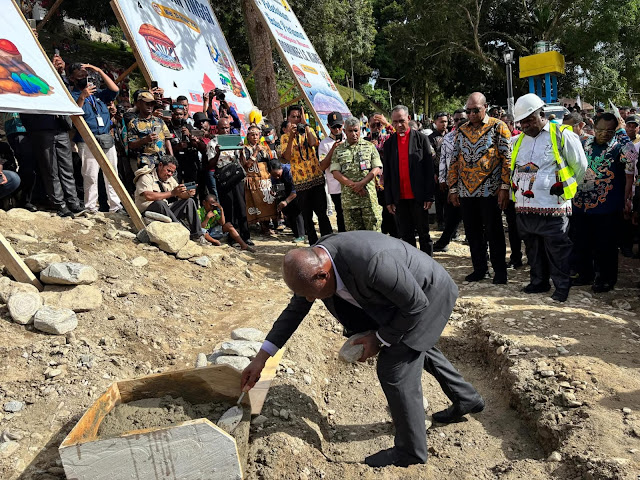
One of the highlights was the ground-breaking of several strategic infrastructure projects:
- A new airport, the Bandara Domine I.S. Kijne
- Monuments like a “I.S. Kijne Statue” and a “Salib Agung Monument”
- A new higher-education institution in his name “I.S. Kijne”.
These announcements reflect the ambition to link the commemorative event with tangible development—transportation, education and landmark—as part of a broader vision for Papua’s future.
Unity Beyond Religion and Generation
An especially uplifting feature was that this Christian-rooted commemoration resonated across faiths and ethnicities. For example, from nearby Raja Ampat, a Muslim youth leader, Fahmi Macap, publicly extended his congratulations to the Christian community for the 100-year milestone of civilisation in Wondama. “Selamat 1 Abad Peradaban Orang Papua, Kasih Kristus menggerakkan Kemandirian Gereja, Menjadikan Manusia Hidup Dalam Peradaban,” he said.
The message from local leaders was clear: the 100-year milestone is not an endpoint but a springboard. The government urged reflection on how far education, health, economy and social welfare have advanced for indigenous Papuans—and how much remains.
The challenge is to ensure that “Papua that advances is Papua that remains faithful to God and does not forget its customs and brotherly love.” Schools and educators are encouraged to embed the legacy of Kijne’s vision into local curriculum—bringing together faith, ethics, and service.
Why This Matters
- Heritage & identity: For the original peoples of Papua (OAP/Ora Alam Papua), such a commemoration affirms their history, identity and contribution to the nation’s story.
- Development linkage: By tying the cultural-spiritual milestone to infrastructure and education projects, the region signals that tradition and modernity can go hand in hand.
- Inter-faith and social cohesion: The inclusive nature of the celebration—including expressions of goodwill across religious lines—strengthens the image of Papua as a region of harmony and respect.
- The main point: The event emphasizes not just being served, but being people who lead themselves—echoing Kijne’s words about “the Papuan people will rise and lead themselves.”
As the sun sets on the centennial mark, the people of Wondama and greater Papua are invited to carry forward the flame lit a hundred years ago. This is a call to renew faith, invest in education, uphold culture, and build a Papua where its own children lead with integrity, service and hope. May this century-mark be more than a symbolic moment—it may be the launch of a new era in which the heritage of the past becomes the foundation of a flourishing and prosperous Papua.
https://www.kompasone.com/2025/10/perayaan-satu-abad-peradaban-papua-di.html

 West Papua Now