

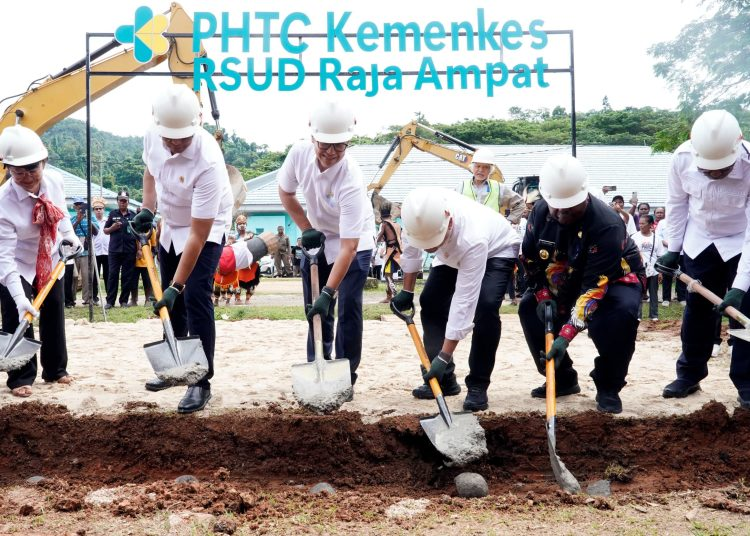
In a landmark move to strengthen healthcare services in Eastern Indonesia, the Government of Indonesia has officially launched the quality upgrading of RSUD Raja Ampat from a Type D to a Type C hospital. This initiative, part of the Ministry of Health’s Ǫuick Win Program, is a key step in realizing the national vision of Asta Cita—President Prabowo Subianto’s eight-point development agenda.
The ceremony, held in Waisai, was attended by Minister of Health Budi Gunadi Sadikin, Head of the Presidential Communication Office Hasan Nasbi, and Presidential Chief of Staff Lieutenant General (Ret.) AM Putranto.
“This is not just about upgrading a hospital—it’s about fulfilling our constitutional promise to provide equal access to quality healthcare for all Indonesians, from Sabang to Merauke, across our 17,000-island archipelago,” said Minister Budi Gunadi Sadikin.
“Through the Ǫuick Win Program, we are accelerating improvements in healthcare infrastructure, especially in remote and underserved regions like Southwest Papua.”
Hasan Nasbi, Head of the Presidential Communication Office, added, “This project sends a clear message: the state is present, responsive, and committed to uplifting every Indonesian citizen, especially those in frontier and disadvantaged areas.”
“It reflects our national resolve to bring quality healthcare to even the most remote corners of Indonesia,” he added.
The upgraded RSUD Raja Ampat will feature expanded services including ICU, HCU, PICU, advanced diagnostic imaging, and a cardiac catheterization lab. It will also offer comprehensive specialist care in surgery, internal medicine, pediatrics, and obstetrics—services that previously required patients to travel to Sorong or Makassar.
Soon the upgraded RSUD Raja Ampat will be able to serve as a regional referral hospital with mid-level (strata madya) capabilities, equipped to handle catastrophic illnesses such as heart disease, stroke, cancer, and kidney failure. It will also strengthen maternal and child health services.
Key medical equipment to be installed includes a CT scan, mammography, cardiac catheterization lab (cath lab), NICU, and chemotherapy units.
Presidential Chief of Staff AM Putranto emphasized the broader national impact of upgrading healthcare facilities is a tangible expression of Asta Cita—ensuring that development reaches every corner of the nation.
“It is a symbol of our unity and our shared future,” he said.
Raja Ampat District Hospital is the 15th local healthcare facility to receive central government support. Previous facilities that have benefited from similar revitalization efforts include:
● RSUD Reda Bolo (Kabupaten Sumba Barat Daya)
● RSUD Borong (Kabupaten Manggarai Timur)
● RSUD Akhmad Berahim (Kabupaten Tana Tidung)
● RSUD Kabupaten Bengkulu Tengah
● RSUD Pongtiku (Kabupaten Toraja Utara)
● RSUD Bobong (Kabupaten Pulau Taliabu)
● RSUD Maba (Kabupaten Halmahera Timur)
● RSUD Tarempa (Kabupaten Kepulauan Anambas)
● RSUD Tafaeri (Kabupaten Nias Utara)
● RSUD KH Muhammad Thohir KRUI (Kabupaten Pesisir Barat)
● RSUD Kabupaten Kubu Raya
● RSUD Kabupaten Buton Tengah
● RSUD Kolaka Timur
● RSUD Konawe Kepulauan
This growing list of upgraded hospitals reflects the government’s commitment to close the healthcare gap between urban centers and remote areas. The revitalization of RSUD Raja Ampat is part of a broader 2025 agenda to construct or upgrade 66 regional hospitals, with a strong focus on equitable healthcare access in frontier, outermost, and least-developed regions.
The Ministry of Health is targeting the construction or upgrade of 32 regional hospitals in 2025, prioritizing underserved and geographically isolated areas. Another 34 local hospices will also be revamped next year.
Southwest Papua Governor Elisa Kambu expressed deep appreciation for the central government’s attention. “This hospital is not just a building—it’s a beacon of hope and a lifeline for the people of Southwest Papua,” he said. He also stressed the importance of developing local medical talent, especially among Papuan youth, to ensure the hospital’s long-term sustainability.
Raja Ampat’s unique geography—comprising four major islands—presents logistical challenges. Governor Kambu and Regent Orideko Iriano Burdam both emphasized the need for a strong, integrated referral system and supporting health centers (puskesmas) to ensure timely emergency care.
“We are fully committed to overseeing this project to ensure it truly benefits the people of Raja Ampat and surrounding areas,” said Regent Burdam.
This initiative is a cornerstone of Indonesia’s broader mission to deliver justice and equality in healthcare, ensuring that no citizen is left behind—regardless of where they live. To further enhance the quality of life of Indonesians, President Prabowo Subianto administration has also rolled out free health checks for all 283 million Indonesians and a massive campaign to end tuberculosis in the world’s second-largest TB-burdened country.

 West Papua Now