

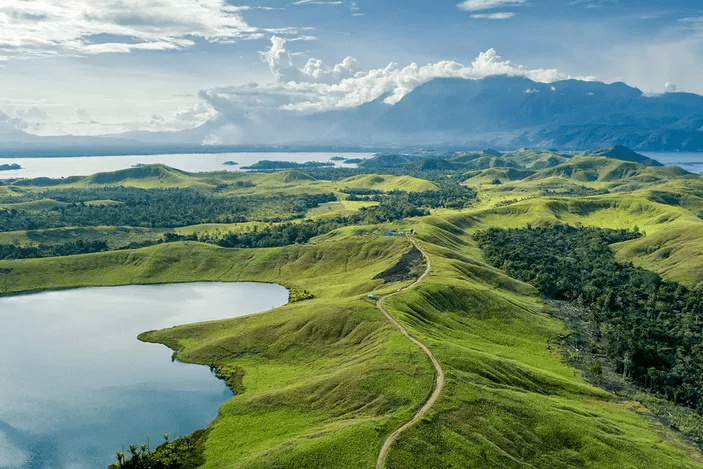
The Cycloop Mountains are not merely a mountain range but also the heart of life for the local community. Administratively, the Cycloop Mountains are located within the City and Regency of Jayapura. The area stretches from west to east for 78 kilometers from Kampung Maribu, Sentani Barat District, Jayapura Regency to Pasir Enam, Jayapura Utara District, Jayapura City.
The Cycloop Mountains, covering an area of 31,479.89 hectares, are a mountain range known by several names, namely the Dobonsolo Mountains, the Dafonsoro Mountains, or the Robhong Holo Mountains. The highest peak of Mount Dafonsoro reaches 1,580 meters above sea level (masl), while Mount Dobonsolo or the Robhong Holo Mountains reaches 1,970 masl.
The Cycloop Mountains are an important area that must be preserved, as it serves as a nature reserve protecting the diverse flora and fauna endemic to Papua.
A number of florae that grow in this area include several types of orchids such as black orchids, iron orchids, black emerald orchids, yellow emerald orchids, yellow orchids, tie orchids, pineapple orchids, rabbit orchids, and pouch orchids.
In addition, the endemic fauna of Papua that breeds in this mountainous area includes birds of paradise, cassowaries, Irian spiny-cusks, and tree kangaroos.
Therefore, in order to maintain the conservation and sustainability of the Cycloop Mountains, commitment and collaboration are needed, not only from the Government but also from local communities, Non-Governmental Organizations (NGOs), academics, and other related agencies or institutions.
“The success of the conservation efforts in the Cycloop Mountains greatly depends on the strong commitment and cooperation of all stakeholders,” said the Acting Head of the Forestry and Environment Office of Papua Province, Aristoteles Ap, emphasizing.
Community empowerment
The success of preserving the Cycloop Mountains Nature Reserve greatly depends on the commitment of the Jayapura City and Regency Governments as well as other community elements.
For that reason, close cooperation and strong synergy are key to the success of preserving the forests in Papua Province. “We believe that a collaborative and participatory approach is the key to success in forest management in Papua,” said Aristoteles.
In order to support the program, the regional government is empowering the community through the production of Non-Timber Forest Products (NTFPs). By the end of 2024, there will be 45 forest farmer groups with various products such as sago sticks, ice cream, bamboo combs, pure coconut oil, noken, bark paintings, head ornaments, and curly sago nuts spread across the city and regency.
Another program is to develop ecotourism, such as creating mangrove forest tracking in Enggors, crocodile river tracking in Koya, sago tracking in Kampung Yoboi, and forest tracking in Genyem.
The Papua Natural Resources Conservation Centre (BBKSDA) empowers the community by forming community empowerment groups. In this way, the community is expected to become more aware of the importance of preserving Cycloop.
“We place facilitators in each group so that the community not only receives assistance but also obtains intensive guidance, thereby indirectly becoming more aware of the importance of preserving Cycloop,” said the Head of the Planning, Protection, and Preservation Working Group of the Papua Natural Resources Conservation Center (BBKSDA), Taufik Mubarak.
In 2024, BBKSD allocated funds for facilitating productive economic enterprises in conservation areas amounting to IDR 1.26 billion. The assistance was distributed to 50 groups in Jayapura Regency and City.
The community empowerment group carried out several stages of activities starting from group assistance, monitoring and evaluation, to support for productive economic enterprises.
In Jayapura Regency, for example, there are orchid plant groups, limited tourism groups for birds of paradise, as well as several fishing and plantation groups around the conservation area. In 2025, the government is also planning the formation of business groups.
The method of managing mountainous areas through community empowerment in conservation areas is one of the innovations in management that is fair and sustainable. In this way, the community can help preserve the forest without neglecting what is truly needed.
The complexity of the issues in the Cycloop Mountains demands the involvement of many parties to find a joint solution. Bio-physically, the Cycloop Mountains area is located in the highlands, while the residents’ settlements are situated below it. Therefore, damage in the upstream area will directly impact the downstream region, both in the form of clean water crises and potential disasters such as floods and landslides.
From an institutional perspective, BBKSDA Papua actively participates in cooperation with various parties concerned about Cycloop. However, until now, there are still people who encroach on the area. Based on the research conducted by the Faculty of Agriculture, Forestry, and Marine Science Ottow Geisler over the course of a year, there are indications of water pollution, which signifies that this area continues to be opened up and is getting closer to the Cycloop Nature Reserve.
“Regulations are already in place, but in practice, there is still tolerance towards violations.” “There should be strict action if there are individuals who commit environmental destruction,” said the academic from Ottow Geissler University Papua, Frank L. Apituley.
Sanctions for illegal loggers
The Jayapura Regency and City Governments have issued regional regulations regarding the management and protection of Cycloop. “We, the people in the Cycloop area, fully support the preservation of its sustainability.” However, on this journey, there are certainly many challenges, including the degradation of the area due to human activities. For that reason, strict sanctions need to be enforced,” said the Coordinator of the Tabi Region Customary Council Association, Papua Province, Daniel Toto.
If no firm action is taken, deforestation will continue, raising concerns that the flash flood incident in 2019 in Jayapura Regency will be repeated. “The tangible impact of the Cycloop damage, one of which was the flash flood disaster that struck Sentani in 2019.” The incident claimed hundreds of lives and damaged thousands of homes,” he said.
Therefore, individuals who open plantation lands in the Cycloop Nature Reserve area must be dealt with firmly. Addressing the issues in Cycloop is not only the government’s duty but also a shared responsibility, especially among the stakeholders. As a conservation area that serves as a water source and plays a crucial role in disaster mitigation, the preservation of Cycloop must be continuously maintained. The preservation of the Cycloop Nature Reserve is the preservation of the endemic flora and fauna of Papua.
https://www.netralnews.com/menjaga-cagar-alam-cycloop-demi-kelestarian-flora-fauna-di-tanah-papua/

 West Papua Now