

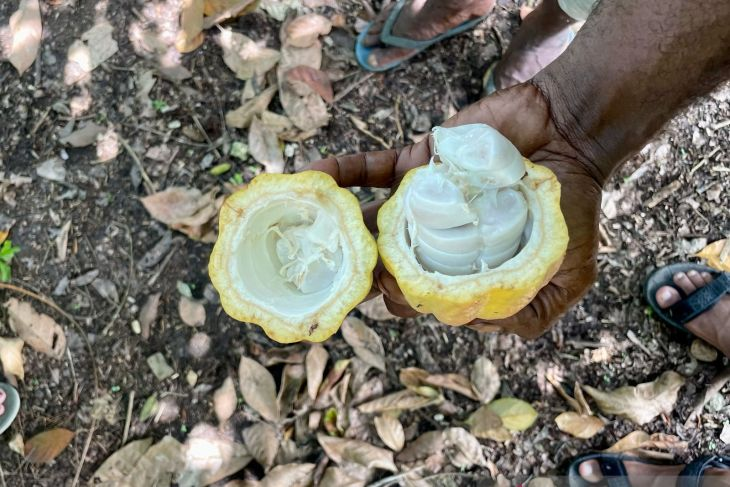
The chirping of the Undo Bayo birds echoed in the Grime Nawa Valley, awakening life to greet the dawn in Papua. Its voice pierces through the narrow gaps in the tropical rainforest vegetation, which serves as the habitat for Papua’s unique flora and fauna.
Meanwhile, from a distance, a stretch of cocoa plantations can be seen thriving in the 900-thousand-hectare valley. This valley is divided by the flow of the Grime River, which crosses the territories of Kemtuk, Klesi, and Namblong. Meanwhile, Nawa crosses Kaureh and Kautabakhu. These areas are located in the Jayapura Regency.
Photovoices International (PVI) in collaboration with the ORPA, a local women’s organisation of the Namblong Tribe and Suara Grina, brought ANTARA to the heart of the Grime Nawa Valley, Insar Village, on Tuesday (11/2).
The village is inhabited by 411 people in 106 households. They are from the Hamong, Giay, Irab, and Hembring clans. This region is famous for its high-quality cocoa plants since the Dutch invasion era in 1932.
A cocoa farmer, Ferdinand Giay (49), mentioned that almost every family in Kampung Imsar has a cocoa plantation. But, since their plants were attacked by cocoa fruit-sucking bugs (Helopeltis spp), fungi, and fruit borer pests in mid-2019, they started abandoning the cocoa gardens, so they were no longer maintained.
Ferdinand is among the cocoa farmers who have persevered since 1997 until now. Although his crops were damaged by pests, they remained the main economic support for the family thanks to the technique of smoking the garden to repel insects.
The end of 2024 marks a new chapter for the revival of cocoa plants in Imsar Village. The Jayapura Regency Government has introduced a new seed variant that is claimed to be more pest-resistant and has begun distributing it to the community.
Some new seedlings have been sown using the budding method through the grafting technique, and most have reached a harvest of around 40 kilograms per resident’s garden. The harvest is handed over to a Japanese middleman at varying prices.
The price of wet chocolate or cocoa in standard condition or small size is priced between Rp20 thousand to Rp30 thousand per kilogram. For dry cocoa, it is sold at Rp95 thousand per kilogram.
Market influence
One of the managers of the cocoa farmers’ cooperative, Yafet Irap, revealed that the cocoa plants in Imsar Village, which had previously experienced failure, were not due to pest attacks, but rather due to the lack of market demand. “The problem is not pests, but because there is no market.” Cocoa is left to dry on the tree, not harvested, and eventually spoils,” he said.
Since 2019 until 2023, farmers were forced to abandon their cocoa farms and switch to planting vanilla and agarwood.
Previously, around 40 farmers in the Imsar region joined a cooperative to manage and sell their cocoa harvests. Production had reached 10 tons per year. However, due to the lack of market certainty, many farmers choose not to maintain their orchards anymore. “If not taken care of, the fruit becomes mouldy and its quality declines.” Actually, it’s not about pests, but because there are no buyers,” he continued, explaining.
The disappearance of the Papua cocoa market occurred because buyers preferred cocoa from Africa, which at that time had an abundant supply. As a result, cocoa plantations in Papua were abandoned for years.
Only in 2024, when the global demand for cocoa increased due to the scarcity of cocoa beans, did the market begin to recover. With the arrival of new buyers, farmers in Imsar are once again enthusiastic about managing their gardens.
International market
Papua has great potential in the global cocoa industry, especially amid the declining cocoa production in Africa due to climate change and land conversion.
Marketing Advisor of PT Kakao Kita Papua, Akiko Tsuru, who was met by ANTARA in Sentani, believes that the quality of Papuan cocoa can still be improved with better fermentation.
“Actually, the potential of Papua’s cocoa is very good, but it hasn’t been maximized yet.” Fermentation must be given more attention because the quality of chocolate highly depends on the level of fermentation,” he said.
PT Kakao Kita Papua, based in Surabaya and Raja Ampat, Papua, has been exporting cocoa from Papua to Japan since 2015. The process begins with the processing of cocoa beans in Java into semi-finished products such as powder, fat, and paste, before being sent to Japan to be processed into various chocolate products.
This company collaborates with farmers in several areas, including Genyem, Imsar, and cocoa farmer cooperatives in Papua. The company focuses on purchasing organic cocoa free from chemicals, resulting in a limited production of around 10 tons per year.
That chocolate product is rare in the world, many people are looking for it. In Africa, production has started to decline due to climate change and land conversion. Farmers there are increasingly switching to palm oil or mining,” he said.
Akiko sees that Papua has a great opportunity to fill that gap because the land in Papua is still vast, the forests can still be preserved, and there is still room to plant cocoa sustainably.
However, the main challenge in Papua is the habit of farmers who prefer to sell cocoa in wet or dry conditions without undergoing optimal fermentation. The fermentation process, which takes about two weeks, is often considered too long because farmers need money quickly.
If the fermentation and processing methods can be improved, Akiko is optimistic that Papua’s cocoa can compete in the global market and become a leading commodity in the future.
Amid the challenges once faced, the resurgence of cocoa in Kampung Imsar marks a new chapter for agriculture in the Grime Nawa Valley. With the increasing market demand and support from cooperatives and export partners, farmers have started returning to their fields, tending to the cocoa trees that were once abandoned.
For the people of Imsar, this revival is not just about the economy, but also about preserving a heritage that has existed since the Dutch colonial era. Amidst the green valleys and the songs of the Undo Bayo birds at dawn, the cocoa trees bear fruit once more, bringing new hope for Papua’s cocoa to the world.
https://www.antaranews.com/berita/4646801/bangkitnya-kembali-kakao-dari-papua

 West Papua Now