

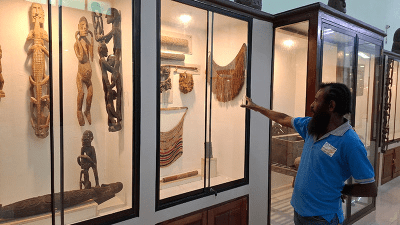
In addition to being a higher education institution, Cenderawasih University also has an asset in the form of the Loka Budaya Museum, which is located near the lower Uncen Auditorium. There are around 2500 collections of cultural artifacts still preserved at the museum. In addition to cultural artifacts, there are also collections of animals such as endemic Papuan birds whose existence is nearly extinct, including the sawfish which is endangered.
The cultural museum located within the campus of Cendrawasih University has become one of the most valuable assets owned by the people of Papua. Papua, which geographically consists of mountainous areas, valleys, coastal regions, and seas, is certainly inhabited by communities that have very diverse cultures and customs.
Visiting the various regions in Papua is indeed quite difficult to do due to the challenging conditions and topography. Besides the distance, transportation access is also still limited; some areas must be traversed by land vehicles, while others require planes or travel via waterways, both sea and river.
For those of us who want to learn about the customs and culture of the Papuans of the past, the evidence of their civilization is still neatly preserved in the Loka Budaya Museum, managed by Cendrawasih University in Jayapura, Papua. This museum is very strategically located near the Jayapura Sentani national road, about 10 to 15 meters from the roadside to reach the museum in the Abepura area.
So, what collections are there in this museum? Based on the account of one of the museum staff, there are currently around 2,500 collections still stored in the museum. Some of the collections are cultural artifacts of the Papuans, and most of them are also made from natural materials such as stone and wood.
Quoting the website of the Ministry of Education, Culture, Research, and Technology, http://www.kemdikbud.go.id, the Loka Budaya Museum was established in 1970 and inaugurated by the Director General of Public Education and Culture, Department of Education and Culture at that time, Ida Bagus Mantra, on October 1, 1973.
There are around 2,500 collections in that museum. Some are still displayed in glass cases, but there are also those that are not displayed. In addition, there are several ethnographic cultural artifacts stored in the museum that have already suffered damage due to age, especially those made of wood.
As for the cultural artifacts in this museum, such as kitchen utensils, items related to past beliefs, farming tools, hunting and fishing equipment, clothing, and body ornaments. Then there are weapons, sacred objects, transportation tools, and musical instruments. There are also wooden carvings, bark paintings, and beads.
“Here there are also wooden pillars for the construction of traditional Sentani houses,” said Soleman Soindemi, sub-coordinator of the Museum, when met on Friday (31/1).
In addition, there is also a collection of endemic Papuan animals such as several types of birds. Even among the preserved bird collection, there are some that can no longer be found.
Several artifacts from the original cultures of the Papuan people are known to be very susceptible to damage or decay, especially those made from wood. This is due to the factor of age. “Here, many are already damaged, so they are no longer available.” That’s because they are rotten from being eaten by termites and others. The damaged items are mostly cultural artifacts made of wood; it’s different if they are made of stone,” he said.
He explained that since the museum was established, around 2500 cultural artifact collections have been neatly stored, especially those that became the first cultural artifact collections collected since the 1960s. However, over time, some of them have been damaged.
Currently, he said, the management has reorganized the security of those items. Among other things, they are stored in glass cabinets and locked, so they are not touched by the hands of visitors.
Then there are also cultural artifacts that have not yet been displayed. Regarding its arrangement, there are several things that need to be considered, starting from its maintenance, where damaged or dirty cultural artifacts need to be cleaned in a conservation laboratory. Then, there needs to be documentation of cultural objects that have suffered damage or disease, which should be documented with photographs.
Next, the history of cultural objects, because the condition of cultural objects is influenced by their history before being received by the museum. “Then, the research on the collection of cultural artifacts stored in the museum needs to be conducted.” Including the placement of cultural artifacts stored in the museum, they need to be placed in exhibition spaces or collection warehouses,” he explained.
He added that currently the museum is still packed with visitors, ranging from students, the community, not only locals but also foreigners.

 West Papua Now