

The sun had just risen from the East, while the nimble fingers of the woman in the blue hijab were busy tearing open the neatly arranged coffee and milk sachets in her motorbike cart. Hot water from the thermos kept flowing, followed by the warm drink concoctions he meticulously prepared for each customer. She is Siti Badriyah, who skilfully delivers orders with a friendly smile.
Siti looks happy. Eyes sparkling. A smile on the lips keeps growing. One by one, the buyers keep coming. That morning, the coffee and food sold by the street vendor at the border between Indonesia and Papua New Guinea were selling like hotcakes.
Although she only works as a ‘starling’ or a mobile coffee vendor, one could say Siti is quite successful there. Imagine, its revenue alone reaches Rp2 million every day. If multiplied by a month, it means tens of millions in revenue.
“The money circulation here is better compared to my village in Java. The income here is better,” said Siti, who has lived in the Papua border area since she was 7 years old.
Since 1982, Siti claimed her parents participated in a transmigration program from Banyuwangi to Papua. And in that border region, it became a place for Siti to earn a living.
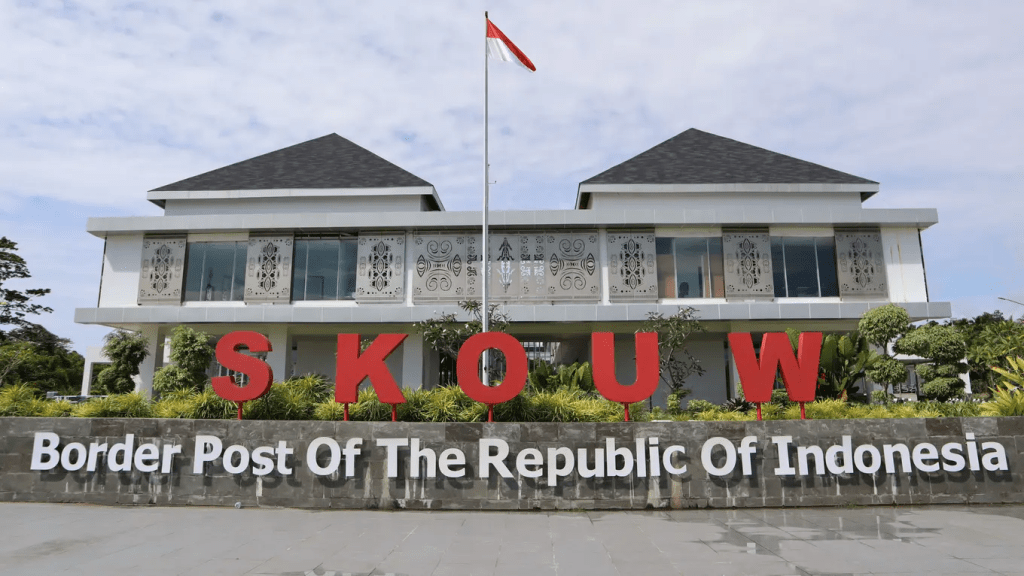
According to Siti, the rapid circulation of money in the area is closely linked to the construction of the Skouw Cross-Border Post (PLBN), Muara Tami, Jayapura City. Along with the luxurious and grand PLBN, economic activities continue to develop there.
Two years ago, Siti recalled, before the PLBN was inaugurated in 2017, her income was at most Rp1 million per day. However, now its revenue has doubled.
No wonder, Siti’s customers are not only Indonesians but also from the neighbouring country, Papua New Guinea. Siti accepts payments in both rupiah and kina, the currency of Papua New Guinea.
Siti sells a glass of coffee for Rp10,000 for Indonesians and 3 kina for Papua New Guineans. Meanwhile, rice with various side dishes like chicken, fish, and eggs is priced at around Rp20,000 and 5 kina. Just so you know, 1 kina is approximately worth Rp3,500-4,000, but it depends on the current exchange rate.
What the government of President Joko Widodo has done in the effort to develop the border area from the Cross-Border Post, as well as the surrounding market, is truly felt by Siti and other residents at the border.
“Now, thank God everything is already good, and the Holtekamp Bridge is also being built, so if it continues to be built, we residents here will definitely be happy,” said Siti.
The same thing is felt by Rasmi, one of the traders in the market located 500 meters from PLBN Skouw. For 10 years, Rasmi has been commuting daily between Abepura and Skouw to sell her goods.
“Alhamdulillah, it’s profitable here, I can eat and send my child to school,” said Rasmi, a migrant from Makassar, South Sulawesi.
Since the border crossing post was repaired, the number of visitors to the market has increased. PNG residents who shop in Indonesia usually come on Tuesdays, Thursdays, and Saturdays. Usually, they buy basic necessities, carpets, nets, and so on.
Economic Activity at the Border
At the inauguration of the Skouw Border Post in 2017, President Joko Widodo firmly stated that the presence of this improved border post must have a real impact on the welfare of the border community.
“Since the first day I was appointed, I have conveyed that the government has clearly stated that border areas should not be forgotten because they are the front porches of Indonesia.” “Just like where we are now, in Skouw, it should be a source of pride for all of us, pride for the people of Papua, and pride for Indonesia,” he said. Thus, Jokowi stated, the presence of the PLBN can function as an economic centre, while also eliminating smuggling practices in the border area.
“I also request that there be guidance so that the items sold are not just the same old things, but developed.” Not only matters related to basic necessities and garments, but also other things like electronics, for example,” he said.
The Skouw PLBN area covers 10.7 hectares and was built from December 2015 to November 2016 by the contractor PT. Nindya Karya (Persero) with a budget of IDR 165.9 billion.
This PLBN can be reached by a land journey of about 90 minutes from the city of Jayapura. The condition of the national road spanning 69 km can now be traversed in good condition.
The design of the Skouw PLBN incorporates local Papuan culture. Its design adapts the characteristic shape of the Tangfa House, a coastal house in the Skouw area, which features a shield-shaped roof and two long rooms for community gatherings.
The use of local ornaments, as well as the application of green building principles makes the border crossing more attractive.
PLBN is designed not only for cross-border services. But becoming a new centre of economic growth at the national border.
In addition to border crossing services in the Core Zone, a supporting zone has also been built, equipped with a tourist market, banking services, an Indonesian guesthouse, and other public service facilities.
Money Circulation
The market and souvenir centre at PLBN Skouw, which stands on an area of 3,600 m² with a total of 506 stalls, is a realization of Presidential Instruction Number 1 of 2021 concerning the Acceleration of Economic Development in the Aruk, Motaain, and Skouw Border Areas.
Based on the data from the Border Security Task Force (Satgas) of the Indonesia-Papua New Guinea Border Security (Pamtas) 122 Tombak Sakti Infantry Battalion, which is the first post before entering the Skouw Integrated PLBN area, it was recorded that outside of market days after the PLBN renovation was completed, visitors reached 300-500, and even on holidays, it exceeded 1,500 visitors.
According to data from the Bank Indonesia representative for the Papua Province in 2018, there is a daily cash flow of Rp3 billion at Skouw Market, which has now become a favourite destination for border crossers from Papua New Guinea to shop for basic necessities.
Many Hidden Gems
PLBN Skouw not only serves its primary function as a border crossing but is also unique tourist destination. It even became a place for selfies, or self-portraits, for people from the border of the two countries.
There are many interesting photo spots there combined with unique local cultural ornaments and the pristine environment.
“So actually, this PLBN has also become a tourist destination,” said the Secretary of the National Border Management Agency (BNPP), Zudan Arif Fakrulloh.
At the Skouw border, people can enjoy the typical cuisine of Papua New Guinea. Like lamb meat, cassava-sized sausages, fried bananas, and local canned drinks.
Tourists can also visit a hidden gem, namely Kampung Harapan, an indigenous village located near the border. The scenery is absolutely stunning! You will be treated to a stretch of rice fields, hills, and rivers.
Not to mention the beauty of Sroba Waterfall, which has a height of about 50 meters and is surrounded by lush green tropical forests. To reach it, tourists must stop by Kampung Harapan, then walk for about 30 minutes to get to the location.
Or you can also stop by Lake Maribu. It has extraordinary natural beauty. The water is clear and the view of the green mountains. The distance is about 2 kilometers from PLBN Skouw.
To invigorate tourists at the border, the Ministry of Tourism and Creative Economy is reviving the Cross Border Festival in Jayapura. “We will present activities such as art, culture, music, film, and even running,” said Minister Sandiaga Uno during his visit to PLBN Skouw. Sandiaga targets 2,000 foreign tourists to attend the festival. “I want to bring back 1,500 border crossers every day at this PLBN.” That is the best record that we will continue to improve. Then we target 2,000 international tourists to participate in the Cross Border event,” he explained.
To optimize it, in the future, it will be made easier in terms of arrival visas by providing them for free. Then the creative programs in the PLBN area will be collaborated with the Papua Youth Creative Hub (PYCH) which has been inaugurated by President Jokowi.

 West Papua Now