

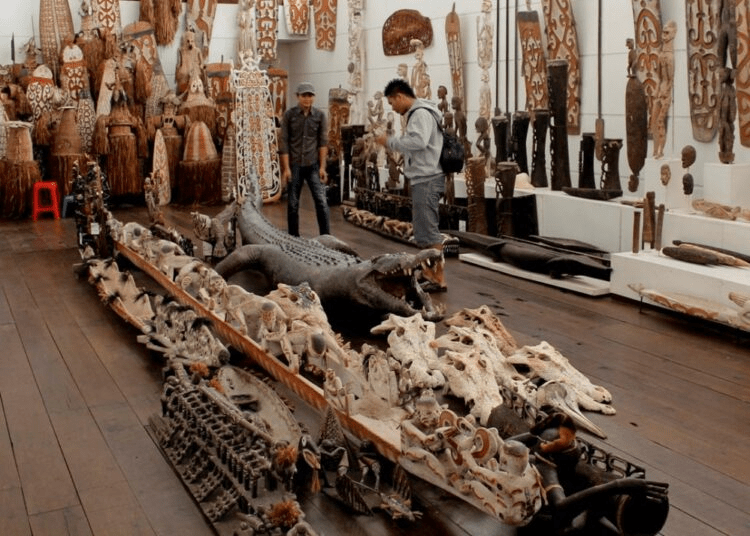
Asmat Regency, located in South Papua Province, has a cultural heritage of Asmat carving that is highly regarded by the world. Carved artworks with intricate carving techniques born from the skilful hands of the Asmat Tribe have made Asmat’s name worldwide.
Asmat wood carving is a cultural heritage that has been carried out for generations by most men in the region. Carving for the Asmat people is believed to be a mediator that connects people’s lives with their ancestors.
Today, Asmat carving is not only sustainable, but also in high demand by collectors and tourists from abroad. Head of the Asmat Regency Tourism and Culture Office, Donatus Tamot, said that Asmat carvings are indeed unique.
“Asmat is indeed very famous for its carving works since long ago as a cultural wealth that is not owned by other regions,” Tamot said on Sunday (16/6/2024).
Asmat carving has the potential to have a positive impact on the progress of the Asmat region. The Asmat Cultural Festival has been initiated by the Diocese of Agats since 1981, when Asmat was just a sub-district (now called a district) in Irian Jaya Province. The Asmat Cultural Festival has played a major role in making Asmat carving art known worldwide.
Now, the Asmat Regency Government through the Tourism Office supports the Asmat Cultural Festival, which has been renamed the Asmat Pokman Festival. “The local government seeks to promote culture in Asmat as a development capital with the diversity of cultures of the tribes and clans in Asmat,” said Tamot.
He explained that the Asmat Regency Tourism Office has the responsibility to contribute to the development of regional progress, by referring to the 11 Objects of Cultural Advancement or OPK cultural heritage as stipulated in Law Number 5 of 2017 concerning Cultural Advancement.
Asmat Pokman Festival
The Asmat Pokman Festival will enter its 37th year in October 2024. The word ‘pokman’ comes from the Asmat language dialect of the Bismam family. Pok means work, and Man/Mban means hand.
Asmat Regent Elisa Kambu said the annual cultural party was held to preserve the cultural arts of the Asmat people. “Dancing, rowing and carving are part of our identity, the Asmat people. That [culture] which distinguish us from people in other parts of the world. We should be heartened that in the midst of globalisation, we still maintain our identity and preserve our local wisdom,” Kambu said.
The Asmat Pokman Festival also fosters brotherhood between sub-tribes or between clans of the Asmat Tribe, as well as building brotherhood with outsiders. The cultural festival has developed and preserved the energy of Asmat sculpture, and introduced Asmat to the world.
Asmat Museum Curator John Ohoiwirin said the Asmat Cultural Feast was initiated by the Bishop of Agats in 1981, Mgr. Alphonse August Sowada OSC, by gathering 36 sculptors from all over Asmat. “The process continued, and the local government became involved in the 1990s,” said John Ohoiwirin.
In the Asmat Pokman Festival, as many as 200 Asmat sculptors gathered and showed off their skills. They are carvers and sculptors who passed the selection stage held in their respective districts.
“In the selection at the district level, which is always done ahead of the festival, we only take 30 nominations from each district. The maximum quota for participants who will perform at the festival [is] 200 carvers,” says John.
Not only showcasing the beauty of sculpting, the Asmat Pokman Festival also presents a variety of other Asmat cultural arts. Such as attractions, dance, and woven crafts.
The Asmat Pokman Festival is expected to increase the creative economy sector in Asmat. The festival has been included in the Karisma Event Nusantara (KEN) calendar, an agenda of the Ministry of Tourism and Creative Economy. A total of 110 events are included in the KEN calendar, consisting of 100 featured events and top 10 events.
The Asmat Pokman Festival collaborated and participated in the promotion of the event at KEN Festival 2024. Donatus Tamot said the festival was also promoted by the Ministry of Tourism and Creative Economy. “There will be many positive things, tourist visits to Asmat will also increase,” Tamot said.
The Asmat Pokman Festival is a bridge for Asmat carvers to market their work to international enthusiasts. Their carvings will be valued up to tens of millions of rupiah at an auction that takes place in Agats, the capital of Asmat Regency, on one of the festival days.
During the Asmat Pokman Festival in 2023, the proceeds from the purchase of carvings and various creative economy products could reach more than Rp 3 billion. Meanwhile, the budget disbursed by the Asmat Regency Government to help implement the festival reached Rp1.4 billion.
“[The Rp3 billion value] is [just calculated] from the carvings that were auctioned and the woven works that were bought. The contribution from the event is very potential. We saw the number of guests who came, hotels in Asmat were full with the festival, their turnovers went up,” said Tamot.
Travelling the world
Bernard Bicimpari is grateful for his life as a native son of Asmat who preserves the tradition of carving. He is a carving artist, called Wow ipits in Asmat terms. With his skills, Bicimpari travelled to several countries to introduce Asmat culture and carving.
The 48-year-old teacher at an Arts Vocational High School in Asmat began to explore his skills as a Wow ipits since he was in elementary school. It started when he saw his parents making Asmat carvings.
When he was in grade 3, Bicimpari participated in the Asmat Cultural Festival in 1985. Although his carving was not perfect, Bernard’s work was sold for Rp90,000. He was proud that his work was appreciated and motivated to continue studying carving.
“My carving at that time was not very good, it could only enter the auction and was valued at IDR 90,000. I was 12 years old at the time,” he said.
Since then, Bicimpari has never missed a moment of the Asmat Cultural Festival. Appreciation for his work continues to rise. He became one of the best carving artists in Asmat Regency, and his work was once sold for Rp8.9 million.
In 2016, he was invited to give carving training at a university in Minnesota, USA. “I taught carving there,” he said.
That same year, Bicimpari travelled to several areas in the United States, such as Chicago, Indiana, Arizona and California. His expertise also took him to Japan and Singapore. “That gave me the motivation to keep going,” he says.
Bicimpari’s carvings are ordered by many collectors in Indonesia and abroad. “The number of my carvings cannot be counted anymore. In America, the furthest away, [my works are bought] starting at US$150. Economically, [the appreciation of the carvings] has a huge impact,” he says.
John Ohowirin, always the curator of the Asmat Museum managed by the Diocese of Agats, also said that the appreciation of Asmat carving has an impact on the economy in Asmat, although the impact is not yet sustainable. “When the festival is held, they [Asmat artists] get proceeds from the auction of carvings, weavings, and others,” John said.
Export opportunities
The preservation of Asmat carving culture is inseparable from the role of the first Bishop of Agats, Mgr. Alphonse August Sowada OSC. The American-born bishop was an anthropologist who served in Asmat since 1961, and became Bishop of Agats in 1969. Bishop Alphonse travelled to various villages, approaching elders and indigenous people to revive and preserve their culture.
In order to accommodate the work of Asmat carvers and Asmat cultural objects, the Diocese of Agats built a museum in 1971. The museum, pioneered by RP missionary Frank Trenkenschuh, was officially opened in 1973.
The Asmat Museum became a bridge or connecting medium to market the work of Asmat carvers. John Ohoiwirin explained that the museum has an art shop that accommodates the work of Asmat carvers.
“So, they come with their carvings and sell them here. In this museum, a 30cm statue is priced at Rp100,000. The most expensive one can reach Rp2 million. Recently, someone from Bali bought a statue of Mbis [for] Rp6 million,” he continued.
The Asmat Museum’s collection is growing, now reaching more than 2,400 collections. The various collections are an attraction for domestic and foreign tourists.
The Asmat Museum is not merely a place to store and exhibit Asmat art and culture, but also a hub for museums abroad to find valuable Asmat carvings and cultural objects to collect.
Museums in a number of European countries, such as the Netherlands, Germany, the UK, France, England, Sweden, and Switzerland, have collections of Asmat carved artworks. So do a number of museums in the United States and Australia.
“The Asmat Museum is like the centre of museums abroad. We are now rebuilding the network with them out there. Museums in the Netherlands, the UK, Germany, Australia, France, America, Sweden and Switzerland all collect Asmat cultural objects,” said John.
“There is an increase in visitors, because there are visitors every day. Foreign tourists just came last month, totalling 75 people. But they don’t just [visit] the museum,” says John.
The appeal of Asmat carvings has even attracted many international enthusiasts. John Ohoiwirin said the export potential of Asmat carvings is great. “I [once] sent Mbis to Brisbane, Australia, [Mbis cost] Rp10 million, with a length of 8 metres,” he said.
According to the Head of the Asmat Tourism and Culture Office, Donatus Tamot, Asmat carved artworks have often been exported to various Asian countries, Europe and the United States. “Usually they send them to Bali, and from there they are sent abroad. The most expensive ones can be around Rp30 million – Rp40 million and even higher,” said Tamot.
https://jubi.id/seni-budaya/2024/seni-ukir-asmat-warisan-budaya-yang-mendunia/

 West Papua Now